Managed Lane Trends: Why Vehicle Occupancy Detection is gaining momentum worldwide


Today, 55% of the world’s population lives in urban areas, and that figure is expected to reach 68% by 2050, adding approximately 2.5 billion people to cities. This continued urbanization will place increasing pressure on transportation networks and road infrastructure worldwide.
The challenge is particularly visible in the United States. While vehicle miles traveled have increased by more than 70%, highway capacity has grown by only 0.3%. Expanding roadway infrastructure alone is often difficult, costly and time-consuming, especially in rapidly growing urban regions. Transportation authorities are therefore looking for smarter ways to manage traffic and make more efficient use of existing road networks.
Managed lanes are becoming an increasingly important part of this approach.
Managed lanes as part of modern traffic management
Managed lanes include express lanes, High Occupancy Vehicle (HOV) lanes and High Occupancy Toll (HOT) lanes. They enable transportation agencies to actively manage how road capacity is used, for example by prioritizing vehicles with multiple occupants, applying dynamic tolling models or providing more reliable travel options during periods of high demand.
As urban areas continue to grow, managed lane programs are expanding in many regions. Their success, however, depends on the ability of road operators to apply access and occupancy rules fairly, consistently and efficiently.
Traditionally, vehicle occupancy has often been checked manually by law enforcement personnel. This approach can be costly, resource-intensive and limited in frequency. At the same time, reliably identifying vehicle occupants at highway speeds presents significant technical challenges. Tinted or heat-absorbing windows, changing light conditions, adverse weather and different vehicle types can all affect detection quality.
As a result, automated enforcement is becoming increasingly relevant to the operation of managed lanes.
Several developments are supporting this shift. Camera and sensor technologies continue to advance, AI-based image analysis is becoming more capable, and legislative frameworks, particularly in the United States, are increasingly enabling automated approaches. Together, these developments are helping transportation agencies integrate enforcement more effectively into their broader traffic management strategies.
Technology enabling smarter managed lane operations
Vehicle Occupancy Detection, or VOD, is an important component of this evolution. It enables transportation agencies to automatically determine the number of occupants in a vehicle and use that information to support HOV and HOT lane enforcement.
Yutraffic InsideAI is Yunex Traffic’s AI-based solution for automated vehicle occupancy detection. It has been developed for use under real-world highway conditions and is designed to support passenger counting in free-flow environments at up to 125 mph, or 200 km/h.
The technology can be used for
- HOV compliance checks,
- occupancy-based tolling,
- value and congestion pricing models,
- carpool initiatives,
- multi-lane free-flow tolling installations
- and applications at toll plazas.
Rather than relying on conventional image analysis alone, Yutraffic InsideAI can provide a standalone passenger detection solution, or be integrated with multiple technologies to create a complete vehicle passage record through sensor fusion in the Sensus Monitor roadside unit. Optional technologies for the full evidentiary record include LiDAR-based classification triggers, and license plate recognition hardware and software.
This combination supports reliable occupancy detection under varying traffic, lighting and environmental conditions.
From vehicle detection to a comprehensive passage record
As a vehicle approaches the HOV lane enforcement zone, a LiDAR detector triggers a custom Yunex Traffic illumination and camera system. The system then captures a sequence of high-quality images as the vehicle passes the detection point.
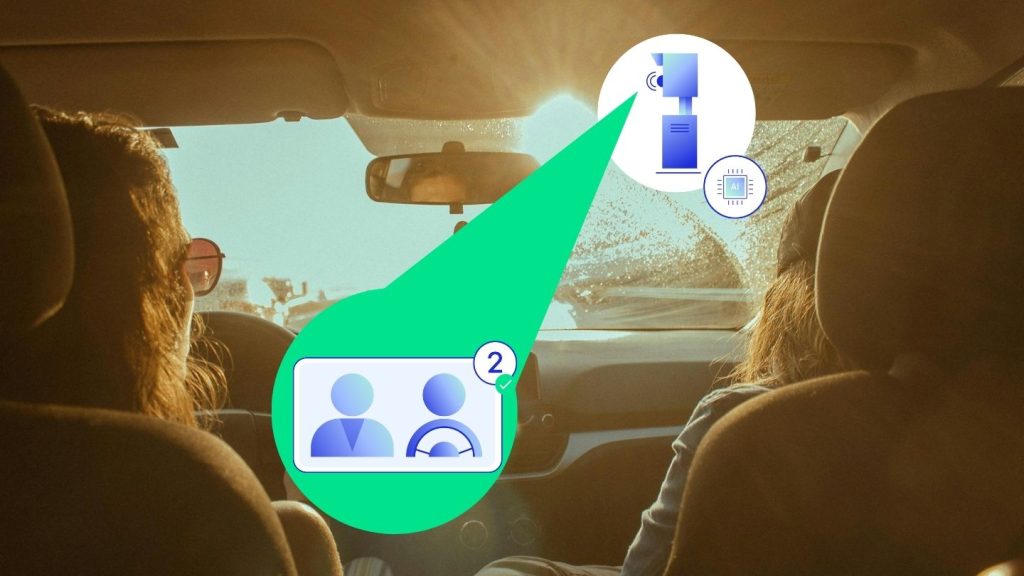
These images are processed by the Yutraffic InsideAI Unit. AI algorithms sort and analyze the image data, detect the visible occupants and determine the number of passengers in the vehicle.
The occupancy result is then combined with additional vehicle and license plate information within the Sensus Monitor roadside unit. This creates a comprehensive vehicle-passage record that can be used for enforcement and operational purposes.
For privacy purposes, this record has the option of providing visible, blurred, or blacked out passenger faces depending on the need of occupant identification.
By automating this process, transportation agencies can conduct compliance checks more efficiently and reduce their reliance on frequent manual occupancy inspections.
Performance continues to advance
Vehicle Occupancy Detection technology continues to improve as AI models, imaging systems and sensor capabilities evolve.
In trials conducted to date, Yutraffic InsideAI has achieved a vehicle detection rate of 99.8% and up to 99% correct occupancy reads for 2+ HOV scenarios. These results demonstrate how advanced detection technology can support transportation agencies in identifying potential violations and ensuring that HOV and HOT lanes are used as intended.
Previous testing under real-life conditions has also included more than 3,000 recorded vehicle occupants across different times of day and varying light conditions. In a 2+ HOT scenario, 97.86% of images from compliant vehicles were correctly classified as compliant and would therefore not have required a manual check. In a 3+ HOT scenario, only 0.19% of images from non-compliant vehicles were incorrectly classified as compliant, limiting potential toll leakage caused by false detection.
These results reflect the importance of combining AI-based analysis with dedicated illumination and sensor technologies. This integrated approach helps address typical VOD challenges such as tinted windows, heat-absorbing glass, sun protection systems and limited visibility.
Benefits beyond enforcement
Accurate Vehicle Occupancy Detection is not only an enforcement tool. It can also contribute to the overall effectiveness of managed lane programs.
Consistent application of occupancy rules helps protect the reliability and performance of managed lanes for compliant drivers. It can make carpooling incentives more credible, support occupancy-based pricing models and help transportation agencies make better use of available roadway capacity.
For HOT lane operators, improved detection can also help reduce revenue leakage by identifying vehicles that do not meet the required occupancy criteria. At the same time, fewer compliant vehicles need to be referred for manual review, supporting more efficient enforcement processes.
In this way, technologies such as Yutraffic InsideAI form part of a broader shift toward data-driven traffic management. They enable agencies to manage road capacity more dynamically without depending exclusively on costly infrastructure expansion.
Continuing development for diverse operating environments
The requirements for managed lane enforcement differ between regions, road networks and operating models. Traffic speeds, lane configurations, vehicle fleets, weather conditions and legal frameworks can all influence how occupancy detection systems need to perform.
Yunex Traffic is therefore continuing to test and refine Yutraffic InsideAI through additional pilots in different regions and under a wide range of traffic, environmental and operational conditions. These activities support the ongoing optimization of the algorithms and help validate the technology in increasingly diverse real-world environments.
This continuous development reflects the changing needs of transportation agencies as managed lane programs expand and automated enforcement becomes a more integral part of traffic operations.
Vehicle Occupancy Detection: Looking ahead
As cities and metropolitan regions continue to grow, transportation agencies will need to move more people efficiently while working within the constraints of existing infrastructure. Managed lanes offer one way to address this challenge by allocating available road capacity more strategically.
Their long-term success will depend not only on physical infrastructure and regulatory frameworks, but also on accurate, scalable and reliable enforcement technologies.
AI-based Vehicle Occupancy Detection is becoming an increasingly relevant part of this ecosystem. By combining high-speed imaging, intelligent analysis and sensor fusion, solutions such as Yutraffic InsideAI can help transportation agencies operate managed lanes more effectively, apply occupancy rules consistently and respond to evolving mobility demands.
The next generation of traffic management is therefore not only about adding capacity. It is about using the capacity already available in a smarter and more targeted way.