


Want to know more about our research projects?
Check out more insights and news about our research projects

How can European cities accelerate their journey toward climate-neutral mobility?
The EU-funded SPINE Project is tackling this challenge by supporting 11 cities in testing
real-life solutions that integrate public transport with shared mobility, micromobility, and active modes.
Yunex Traffic plays a key role as a technical partner, providing data-driven tools and algorithms that help cities assess public transport quality and visualize traffic signal coordination. By turning complex mobility data into actionable insights, we help cities move from ambition to implementation – shaping the future of sustainable urban transport across Europe.
SPINE (Smart Public transport Initiatives for climate-Neutral cities in Europe) brings together 11 cities, including Antwerp, Bologna, Las Palmas, and Tallinn – to test and evaluate real-life solutions that integrate public transport with shared mobility, micromobility, and active modes like walking and cycling.
The goal: reduce emissions, improve accessibility, and support the decarbonization of urban transport.
The project is structured around Living Labs: selected urban areas where innovations are tested under real conditions. These include both Lead Cities, which drive implementation, and Twinning Cities, which replicate and adapt the solutions to their local context.
As a technical partner we support cities with tools and algorithms that help assess the quality of public transport.
Our work focuses on two key areas:
The project is currently in the implementation phase. Cities have collected and harmonized historical data in line with Yunex Traffic’s technical requirements. In many cases, this meant developing alternative methods such as using GTFS feeds or equipping buses with GPS trackers to reconstruct vehicle trajectories.
Collaboration with simulation partners like Aimsun has further enriched the dataset. The result is a robust, standardized data model that feeds into our algorithms for public transport quality assessment.

We are currently working with three Lead Cities: Las Palmas, Bologna, and Antwerp and several Twinning Cities including Gdynia, Zilina, and Valladolid.
Each city brings its own infrastructure, challenges, and data landscape. Through continuous dialogue and adaptive collaboration, we’ve helped cities identify suitable monitoring methods, build local capacity, and contribute meaningful data despite varying levels of technological maturity.


By the end of the project, we aim to deliver a standardized, scalable framework for assessing and improving public transport quality across Europe.
This includes:
“It’s been exciting to see how cities overcame local constraints to contribute meaningful data. With ongoing dialogue and a flexible approach, we made sure local circumstances were reflected in the process. That’s what makes the SPINE Project so impactful.”
— Nadine Hrabia, Project Technical Expert at Yunex Traffic and project manager with a focus on data analytics for SPINE
it’s a blueprint for how cities can use data to shape the future of sustainable urban mobility and we are proud to be part of that transformation!
SPINE is just one example of how we support cities in moving from vision to implementation. Across Europe and beyond, Yunex Traffic drives innovation – with research projects that turn complex mobility challenges into practical solutions.
Curious how else we are shaping the future of sustainable mobility? Explore our other research initiatives and learn about the impact they are already making.
Check out more insights and news about our research projects
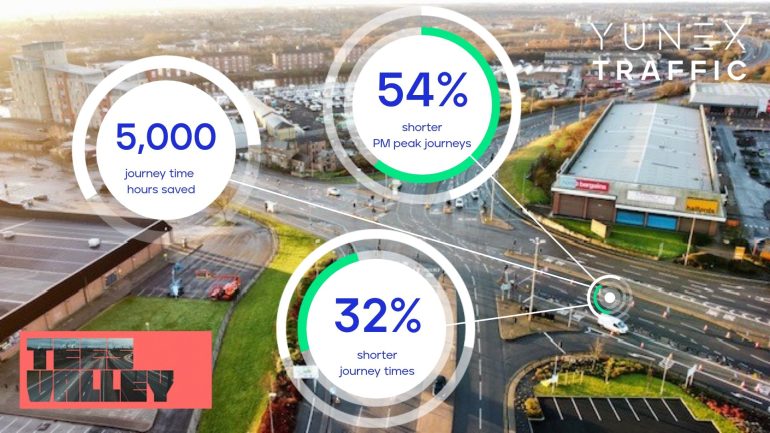
How can a region improve traffic flow when simply adding more road capacity isn’t the answer? Together, Tees Valley Combined Authority and Yunex Traffic are showing what is possible when strong partnership, real-time data and intelligent traffic management come together. Like many regions, Tees Valley faces growing pressure on its road network. More demand, changing…

Get to know your mobility challenges Cities around the world are working to create safer, more sustainable and more efficient transportation systems. Yet achieving these goals is becoming increasingly complex. Mobility leaders must balance growing traffic demand, environmental objectives, budget constraints, evolving technologies and rising citizen expectations. While many cities recognize the challenges they face,…

Weiden, Germany, 6 October 2026. The City of Weiden is the first municipality to deploy Yutraffic awareAI 2.0, the next generation of AI-enabled traffic detection from Yunex Traffic. The deployment marks a key milestone in the global rollout of Yutraffic awareAI 2.0, combining advanced AI-enabled traffic detection, real-time insights and seamless integration to help cities…

Brno, Czech Republic, 30 September 2026. Brno is taking the next step in its mobility journey with a new Traffic Information Center designed to create a single source of truth for traffic operations across the city. Bringing together traffic, parking, public transport and roadway information, the platform will support more informed decision-making and provide AI-enabled…

Belgrade, 28 September 2026. Yunex Traffic has successfully completed the implementation of Belgrade’s Adaptive Traffic Control System, one of the most ambitious urban mobility modernization projects in the region. The new central traffic control system now monitors and manages traffic operations across around 400 intersections in Belgrade, enabling both citywide adaptive traffic control and local…

Weigh-in-Motion (WIM) measures axle loads and gross vehicle weights of commercial vehicles while they are in motion, even at highway speeds. This makes it possible to detect overloaded vehicles at an early stage and direct them to targeted inspections without unnecessarily disrupting traffic flow. As a result, WIM makes an important contribution to protecting roads…