5 questions, 5 answers: How to reduce environmental impact through traffic management?


The transport sector remains one of the largest contributors to global emissions worldwide. Addressing this issue requires innovative solutions that optimize traffic flow, improve air quality, and promote greener transportation options. We spoke with Diana Willert, Chief Sustainability Officer at Yunex Traffic, to discuss how technology and data-driven strategies can help reduce the environmental impact of road transport.
Diana, thank you for speaking with us. The transport sector significantly contributes to global emissions. Why is it so difficult to reduce its environmental impact?
The transport sector remains one of the largest contributors to global emissions, accounting for roughly 20% of global CO2 emissions. The main challenge lies in the complexity of transport systems and the deep-rooted reliance on private vehicles. Urban areas, where over 70% of EU citizens live, generate nearly a quarter of all transport-related CO2 emissions in Europe. Additionally, congestion, inefficient traffic flow, and the slow adoption of greener transport options further exacerbate the negative effects of traffic on our environment. Therefore, it is important to rethink mobility and pursue a holistic, data-driven approach that integrates technology, policy, and behavioral change.
What role does Yunex Traffic play in addressing these environmental challenges?
As a leader in Intelligent Transport Systems (ITS), Yunex Traffic is committed to delivering solutions that reduce emissions and improve urban mobility. Our portfolio includes adaptive traffic management systems, environmental monitoring, and connected mobility solutions that help cities optimize traffic flow, minimize congestion, and promote greener modes of transport. By integrating real-time data with AI-enhanced insights through Yutraffic awareAI, we enable proactive decision-making that enhances both efficiency and sustainability.
You mentioned data-driven mobility management. Can you give an example of how this works in practice?
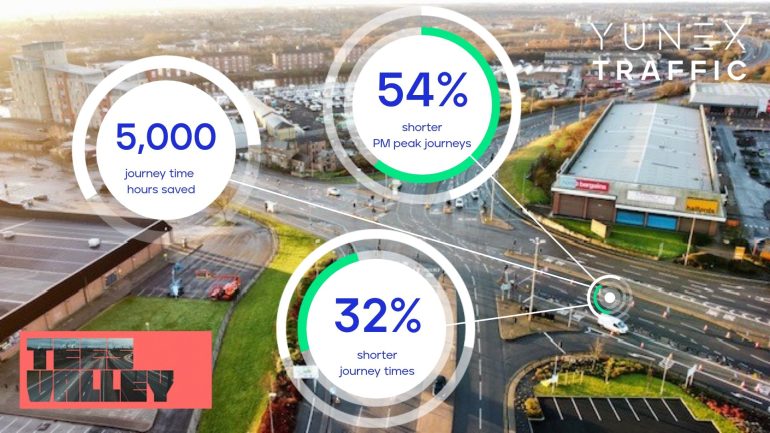
Absolutely. One of our key solutions is Yutraffic FUSION, an adaptive traffic management system that uses digital twin technology to model, simulate, and forecast traffic conditions. By dynamically adjusting traffic signal phases based on real-time and historical data, it optimizes traffic flow and reduces unnecessary stops and accelerations. This not only enhances efficiency but also lowers fuel consumption and emissions. Cities like London and Wiesbaden are already leveraging our solutions to mitigate congestion and improve air quality.
Air pollution is another major concern. How can smart traffic management help improve urban air quality?
Road traffic significantly contributes to pollutants like NO2 and particulate matter, which degrade air quality and harm public health. Our Environmental Traffic Management (ETM) system integrates air quality monitoring with traffic management. By identifying pollution hotspots through IoT sensors and digital twins, cities can implement dynamic measures such as traffic rerouting, speed reductions, or low-emission zones to minimize harmful emissions. This approach has proven effective in cities like Edinburgh and Wiesbaden, where targeted interventions have led to measurable improvements in air quality.
What is your vision for the future of a more sustainable urban mobility?
Our vision is a future where mobility is efficient, connected, and environmentally sustainable. This means shifting towards multimodal transport systems that prioritize public transit, cycling, and walking while integrating advanced technologies to optimize traffic flows. By leveraging AI, real-time data, and digital twin models, we can make mobility infrastructure more adaptive and responsive. At Yunex Traffic, we are committed to supporting countries, regions and cities in achieving their climate goals and making sustainable mobility a reality for all.
Learn more about how Yunex Traffic is reducing the environmental impact of traffic.